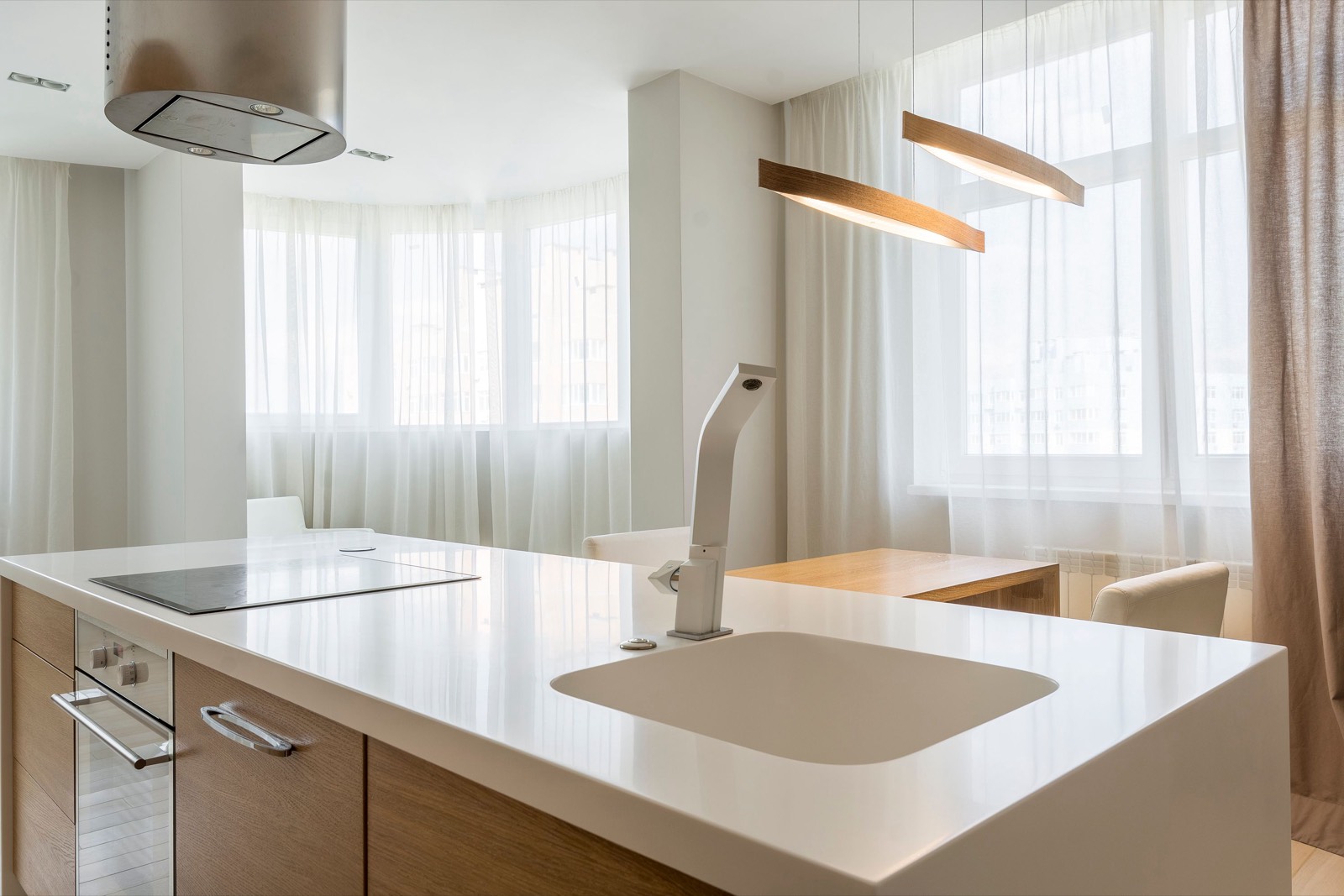
Of all the rooms a curtain retailer quotes, the kitchen is the one where the standard playbook breaks down fastest. A customer who wants the same heading style and fabric as their living room curtains has often not thought through what sits directly under or beside a kitchen window: a sink, a hob, a run of wall cabinets, a handle that swings into the room when the window opens. None of that shows up on a swatch, and none of it gets fixed once the curtain is already hanging.
This guide covers the three styles that actually work on a kitchen window, the fabric and hardware choices that hold up to cooking, and the measuring and safety details that keep a kitchen curtain out of the returns pile.
Why kitchen windows need a different conversation
Three things set a kitchen window apart from every other window in the house, and all three should come up before fabric does.
- Something is usually directly below it. A sink, a counter, or a run of base cabinets sits under most kitchen windows, which limits how low a curtain can hang and rules out anything that would dangle into a wet or working area.
- It gets dirty faster. Cooking throws grease-laden steam into the air, and fabric near the stove or the sink picks up more of it than fabric anywhere else in the house. A kitchen curtain needs washing far more often than a living room curtain cut from the same fabric.
- It sits closer to an open flame or a hot surface than any other soft furnishing in the home. That's a safety question as much as a style one, and it changes which fabrics and lengths make sense near a hob.
None of this means a kitchen window has to look utilitarian. It means the style, fabric, and hardware recommendation should start from these constraints, rather than from whatever the customer already has in the living room.
Three styles that actually work on a kitchen window
Café curtains
A café curtain covers only the lower half of the window, hung from a rod set partway up the frame rather than at the top. It's the classic choice for a window directly over a sink: the lower half gets privacy and screens the view of dishes and clutter at counter height, while the upper half stays clear for daylight. Because the panel is small, it's quick to make, cheap in fabric, and easy to take down and wash, which matters more in a kitchen than anywhere else in the house. Café curtains are also the natural answer when a window handle or crank sits in the upper half of the frame, since the rod and fabric never need to clear it.
Tier sets
A tier set is two stacked café-style panels, one above the other, that together cover the full height of the window. Sold as a pair, often with a coordinating valance across the top, a tier set gives full coverage without a single panel ever reaching down to the sill, the counter, or the sink. It's the right recommendation when the customer wants the window fully dressed but a full-length panel isn't practical given what sits directly underneath it.
Full-length panels, sheers, or a roman blind
Where a kitchen window has clear wall space below it, away from the sink and the hob, a full-length panel, a sheer, or a roman blind becomes a realistic option, and the same fabric and hardware logic used anywhere else in the house largely applies. The fabric and fire-safety considerations below still apply in full, since a kitchen is still a kitchen even when the window isn't directly over the sink.
Fabric that survives a kitchen
Fabric choice for a kitchen curtain should be led by maintenance first, and by look second.
Washability first. A kitchen curtain gets laundered more often than any other curtain in the house, so a machine-washable, easy-iron cotton or cotton-polyester blend is almost always the right default, ahead of fabrics chosen purely for drape or texture.
Tight weave over loose weave. A tightly woven cotton or polyester-cotton sheds grease-laden steam better than a loosely woven linen or a heavily textured weave, which traps it in the fibres and is harder to fully clean.
Pattern has a practical job here, not just a decorative one. A patterned or mid-tone fabric hides staining and general wear far better than a plain, pale fabric hung directly behind a hob or a sink. It's worth raising this with a customer who's leaning toward white or cream purely on looks.
Go light on lining. Heavy interlining or molton, covered in our guide to curtain linings, traps moisture and makes a curtain harder to wash and dry, which is exactly the wrong trade-off in a kitchen. Standard lining or no lining at all is usually the better call here, even on a window where you'd recommend something heavier elsewhere in the house.
Flame-retardant treated fabric is worth specifying on anything hanging within reach of a hob, covered in more detail below.
Hardware for short-drop windows
Café curtains and tier sets need hardware suited to a short, light panel rather than a full-length drop, and the options differ from a standard pole or track.
- Tension rods are spring-loaded and fit inside the window recess without drilling. Fast to fit and good for a rental or a short-term installation, but they can slip under the weight of a heavier fabric or a wider window, so they're best kept to lighter cottons on narrower panes.
- Café rods are slim, fixed rods mounted on small brackets partway up the frame, built specifically for the lower-panel job. They're the more durable, better-finished option, and worth the small extra cost over a tension rod on any order the customer expects to keep for years rather than a season.
- Swing-arm (hinged) rods pivot away from the window on a hinge, which matters on a kitchen window that opens outward or tilts on a crank handle. A fixed rod positioned to clear the handle at rest can still foul it once the window is cranked open; a swing-arm rod moves with the sash instead.
- Rod pocket vs. clip rings. A rod pocket is the simplest, cheapest way to hang a small panel, but clip rings make it far faster to take the curtain down for washing, which, given how often a kitchen curtain needs laundering, is worth the small extra cost of the rings.
Measuring around sinks, handles, and hobs
A few measurements matter in a kitchen that don't come up anywhere else, on top of the width and drop basics covered in our general measuring guide.
- Clearance over the sink or counter. Measure from the counter or sill upward and set the hem of a café curtain or lower tier well clear of it, including some allowance for the panel swinging when the window is open, not just when it's hanging still.
- Window handles. Tilt-and-turn and crank handles, common on continental European kitchen windows, project into the room and sweep through an arc when the window opens. A rod or bracket needs to clear that full arc, not just the handle's resting position, or the fabric will catch on it every time the window is used.
- Distance to the hob. Measure the horizontal distance from the hob to the nearest point the fabric can reach, accounting for a curtain being pushed aside or a window being opened on a breezy day. If that distance is tight, that's a strong argument for a café curtain or a roman blind over a full-length panel, not just a style preference.
Fire safety near the hob
A kitchen curtain hangs closer to an open flame or a hot surface than any other soft furnishing in the home, and that's worth addressing directly with the customer rather than leaving unsaid.
Specify flame-retardant treated fabric on any curtain within reach of the hob, and check local building and fire safety regulations for the minimum clearance required in your market, since requirements vary by country and sometimes by building type. Where the layout allows it, the safer and often simpler recommendation is to keep fabric away from the cooking zone entirely, which is one more reason a café curtain or a shorter tier, positioned and sized to stay clear of the hob, is frequently the right call even when a customer's first instinct is a full-length panel to match the rest of the room.
Upselling a kitchen window order
- A matching valance. A coordinating valance across the top of a café curtain or tier set finishes the look for a small amount of extra fabric and making time, and it's an easy addition to suggest once the main panels are agreed.
- Layering a roman blind underneath. A roman blind handles privacy and light control, while a café curtain or valance does the decorative work on top. This combination suits a kitchen particularly well, since the blind can be raised clear of the sink and counter while the curtain stays purely visual.
- Upgrading the rod. A café rod sits in full view at eye level in a way a full-length pole rarely does, directly over the sink where the customer looks every day. That makes a finished, quality rod a more visible and more easily justified upgrade than hardware in most other rooms.
Why kitchen curtains are hard to sell from a swatch
A fabric that reads well as a full-length living room curtain often looks completely different scaled down to a café curtain's small panel. A large pattern repeat that looks balanced over two and a half metres of drop can look cramped or oddly cropped over sixty centimetres. Customers rarely picture that difference from a swatch, and it's one of the more common sources of a kitchen order that disappoints once it's actually hanging.
Showing the customer their own kitchen window with the café curtain, tier set, or valance combination rendered at the real, short scale solves this directly. It also makes the clearance questions concrete: the customer can see exactly how far the hem sits above the sink or the hob, instead of trying to picture it from a tape measure reading.
Show the exact fit before the customer commits
Generate a photorealistic preview of café curtains, tiers, and hardware in the customer's real kitchen window. 10 free credits included, no credit card needed.
Get Started Free