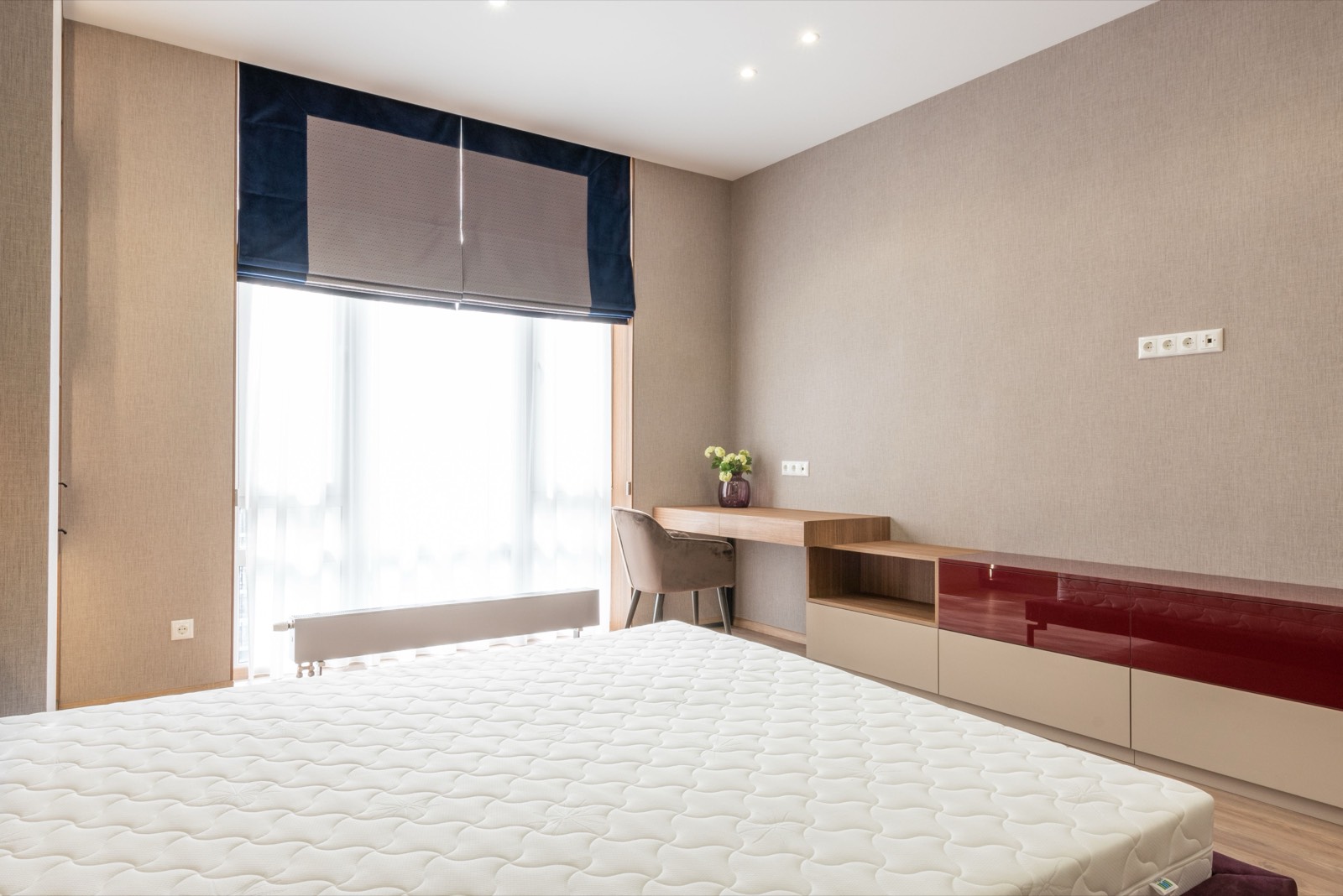
Blinds get treated as an afterthought in a lot of curtain shops, something offered when a customer specifically asks rather than a category sold on its own merits. That undersells both the product and the margin. Blinds solve problems curtains cannot, and a customer choosing between roller, Roman, Venetian, and pleated is really choosing between four different balances of light control, privacy, cost, and maintenance.
This guide covers the four blind types that come up most often in a retail conversation, how to tell customers apart on the questions that actually matter, and the child safety rules that apply to every corded or chained blind you sell.
Why blind type matters more than fabric choice
With curtains, most of the decision lives in the fabric and heading. With blinds, the mechanism comes first, because it decides what the product can actually do once it is installed:
- Light control. Some blinds block light in a single, even sweep. Others let a customer dial in exactly how much light comes through and from which angle, at the cost of being slower to operate.
- Stack and bulk. A blind has to go somewhere when it is fully open. Some fold into a slim stack at the top of the window; others roll into a compact tube. This decides how much glass stays covered even when the blind is "open".
- Maintenance. Fabric blinds collect dust in folds and pleats. Slatted blinds collect it on every slat and need wiping down, not just shaking out.
- Fit for the room. Moisture, direct sun, and how often the blind is operated all rule some options out before fabric ever enters the conversation.
Roller blinds
A single piece of stiffened fabric wound around a tube at the top of the window, unrolled downward using a chain, spring mechanism, or motor. The simplest blind mechanism to manufacture and the easiest for customers to understand, which is a large part of why it is the best-selling blind category almost everywhere.
Look: Clean and minimal. A roller blind reads as almost invisible when fully raised, which suits customers who want light control without adding visual weight to the window.
Light control: Determined entirely by fabric choice. Blackout fabric blocks light completely; a light-filtering or "screen" fabric diffuses it while preserving some view out.
Fit: Kitchens and bathrooms with the right fabric, since roller blinds are the easiest blind type to specify in moisture-resistant or wipeable fabric. Also the default choice for large glazed areas and bifold doors, where a slim, unobtrusive stack matters.
Watch for: Fabric that is too lightweight can flap in a draught from an open window; a heavier fabric or a side-channel system solves this on exposed installations.
Roman blinds
Fabric that folds into neat, horizontal pleats as it is raised, rather than rolling. Structurally a fabric blind, but styled and sold much closer to a curtain, which is why it is a natural upsell for a customer who wants a soft, fabric look without the bulk or fullness of full-length curtains.
Look: Soft and tailored. Available in the same fabric ranges used for curtains, including patterned and heavier weight options that would look wrong on a roller blind.
Light control: Depends on lining, exactly as with curtains. A blackout-lined Roman blind performs close to a blackout roller, but with the pleats reading as a decorative feature rather than a plain panel.
Fit: Bedrooms and living rooms where the customer wants a soft, furnished look. Less suited to bathrooms and kitchens, since the fabric and folds are harder to keep clean than a wipeable roller.
Watch for: When fully raised, the folded fabric still stacks against roughly a fifth of the window height, more than a roller blind. Flag this on shorter windows where every centimetre of glass matters to the customer.
Venetian blinds
Horizontal slats, traditionally aluminium or wood, connected by cords or a tape ladder so the whole set can be raised, lowered, and tilted. Tilting the slats is what sets Venetian blinds apart from every fabric option: light and privacy can be adjusted independently of how far the blind is lowered.
Look: Practical and architectural. Aluminium slats in narrow widths (typically 16 to 25mm) suit a contemporary look; wider wood or faux-wood slats (50mm) read as warmer and more traditional.
Light control: The best of any blind type for fine adjustment. Slats can be angled to let light in while blocking a direct line of sight from outside, which fabric blinds cannot do at all.
Fit: Home offices and rooms where light needs adjusting through the day, and anywhere a customer wants privacy without full darkness. Aluminium slats also tolerate humidity better than most fabric options, making them a solid kitchen and bathroom choice.
Watch for: Slats are more visually prominent than a raised roller or Roman blind, and they collect dust on every surface, so set maintenance expectations at the point of sale rather than after the first complaint.
Pleated blinds
A single piece of crisply pleated fabric that concertinas up and down, sometimes doubled into a honeycomb, or "cellular", construction with two fabric layers enclosing pockets of air. The newest of the four categories in most markets, and the one customers are least likely to already know by name.
Look: Neat, fine pleats that suit modern and minimalist interiors, and fit window shapes a roller or Roman blind cannot, including angled tops, triangles, and skylights, since the pleated fabric holds its shape without a straight top rail.
Light control: Ranges from sheer, light-filtering fabrics through to full blackout, the same spread as roller blinds, plus the option of a top-down-bottom-up mechanism that lets the blind be lowered from the top for privacy while keeping the bottom of the window uncovered.
Fit: Skylights, conservatories, and awkward window shapes where other blind types cannot be fitted cleanly. Cellular versions add a genuine insulation benefit, worth mentioning to customers concerned about heat loss or a room that overheats in summer.
Watch for: Cellular blinds cost noticeably more than a single-layer pleated or roller blind for the same window, so lead with the insulation and light-control benefits before the price, not after.
Fabric blinds versus slatted blinds
Once a customer understands the four types individually, the fastest way to help them choose is to group the decision into fabric (roller, Roman, pleated) against slatted (Venetian):
| Question | Points toward fabric | Points toward slats |
|---|---|---|
| Wants to fine-tune light throughout the day | Yes | |
| Wants a soft, furnished look | Yes | |
| Room gets a lot of direct sun or heat | Cellular pleated | Aluminium tolerates heat well |
| High humidity room | Roller in wipeable fabric | Aluminium slats |
| Wants minimal cleaning | Roller | |
| Awkward or angled window | Pleated |
Most customers have already ruled out half the table without realising it, once the questions are put to them directly rather than left implicit in a product name they don't recognise.
Cord and chain safety: what every retailer must get right
This is not optional detail. Looped cords and chains on corded blinds are a documented strangulation hazard for young children, and product safety regulation across the EU (the harmonised standard EN 13120 for internal blinds) requires manufacturers and retailers to supply child-safety devices with every corded or chained blind sold, whatever the type.
- Cleats and cord tidies. A wall-mounted cleat that the operating cord is wound onto out of a child's reach is the minimum acceptable safeguard, and it only works if it is actually fitted and the customer is shown how to use it, not left in the box.
- Breakaway connectors. Modern looped chains and cords are fitted with a connector designed to separate under load, so the loop cannot form a closed strangulation hazard if pulled hard.
- Tensioners. A cord tensioner fixed to the wall or sill keeps the cord permanently taut, removing the loop entirely rather than just containing it.
- Cordless and wand-operated options. Spring-assisted roller mechanisms and wand-tilted Venetians remove the hazard altogether, and are worth recommending as the default in any room used by young children, a nursery especially.
Beyond the legal obligation, this is a straightforward trust-building conversation with customers who have small children or grandchildren, and one that costs almost nothing to have well. A retailer who raises it unprompted looks more competent, not more cautious.
Helping customers choose
A short set of questions gets most customers to the right blind type faster than talking them through all four options from scratch:
- "Do you want to be able to let light in without people seeing in?" Points straight to Venetian, since tilting is the only mechanism that does this.
- "Is this a bathroom, kitchen, or somewhere that gets steamy or greasy?" Points to roller in a wipeable fabric or aluminium Venetian, and away from Roman or standard pleated.
- "Do you want it to feel more like a curtain, or more like a blind?" Separates Roman from roller and pleated on look alone.
- "Is the window an unusual shape, or is heat loss a concern?" Points to pleated, cellular in particular for the second question.
- "Are there young children in the home?" Should be asked as standard, not left until the safety leaflet is handed over at the end.
Showing the difference instead of describing it
Blinds are genuinely harder to sell from a sample than curtains are, because the sample in a customer's hand is a scrap of fabric or a length of slat, not the mechanism, the stack, or how the finished blind sits in their actual window. Two blinds that use near-identical fabric can look completely different once one is a roller and the other is a Roman, and no swatch communicates that.
A visualization that shows the customer's own window with each blind type rendered in place closes that gap immediately. Once a customer can see their kitchen window with a roller blind next to the same window with a pleated blind, the light control and look differences that are hard to explain become obvious, and the conversation moves from "what is a Roman blind" to "which one do I want", which is a much shorter conversation to close.
Show every blind type in the customer's own window
Generate a photorealistic preview of roller, Roman, Venetian, or pleated blinds in your customer's actual room. 10 free credits included, no credit card needed.
Get Started Free