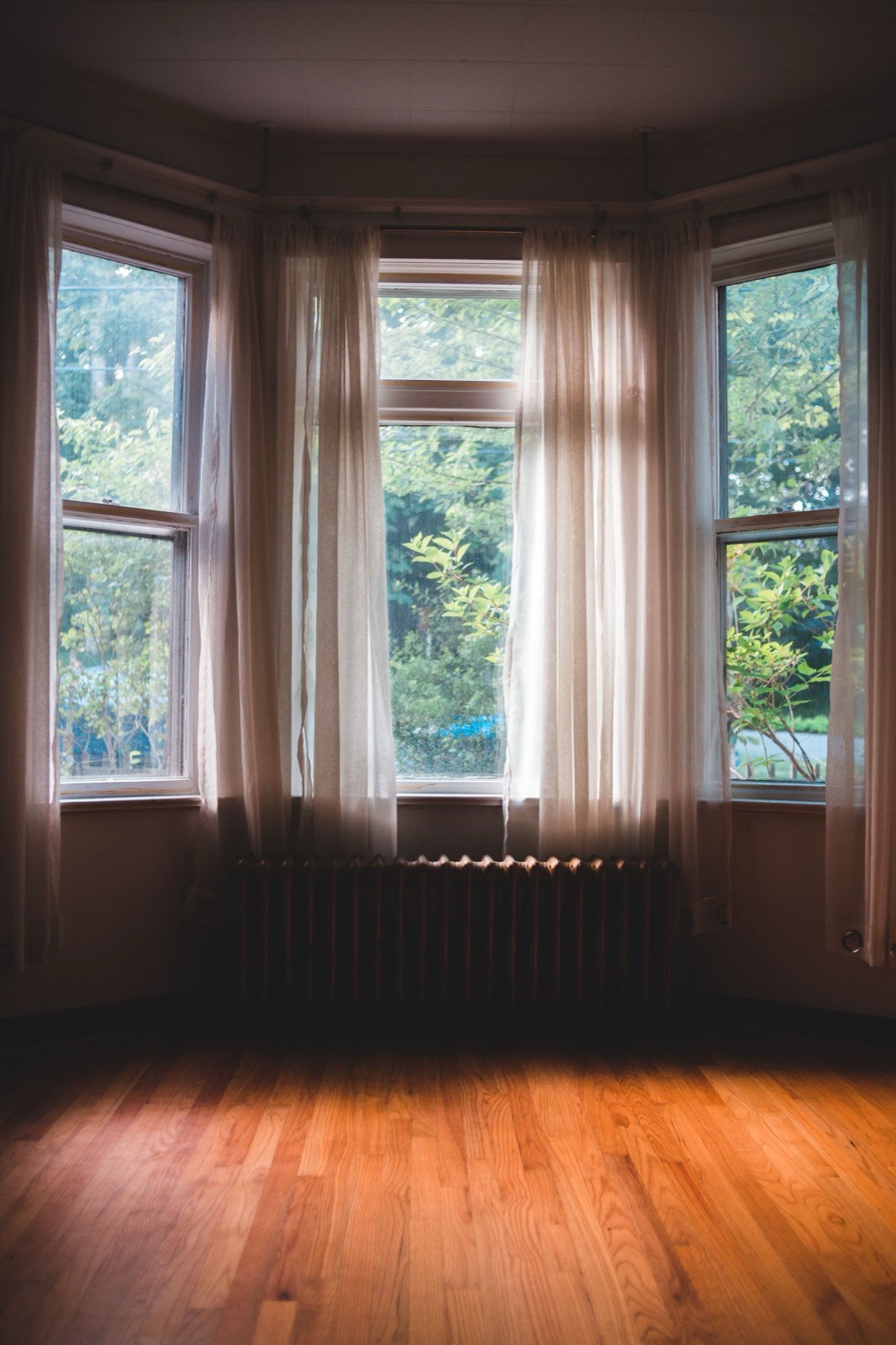
Retailers who are confident quoting a standard window often slow down at a bay, and for good reason. A bay is not one opening with one width and one drop. It is two, three, or more panes set at angles to each other, sitting in front of a wall that itself steps forward into the room. Every choice that is simple on a flat window, the pole length, the heading fullness, the blind width, has to be worked out separately for each pane and then reconciled with the ones next to it.
Get it right and a bay becomes the best-looking window in the house, a natural focal point that sells the whole room. Get it wrong and it is the one job that comes back for a second visit.
Three shapes, three different jobs
"Bay window" covers a few genuinely different layouts, and the plan changes with the shape.
- Square bay. A central pane facing straight out, with two side panes set at 90 degrees. The corners are sharp, which makes this the easiest bay to hang hardware on, since a pole or track can be built from straight sections joined at a fixed angle.
- Angled (canted) bay. The same three-pane layout, but the side panes sit at 120 to 135 degrees rather than a right angle. Common in older housing stock. The wider angle means a straight pole run looks more continuous, but it also means off-the-shelf corner brackets, which are usually made for 90 degrees, often will not sit flush.
- Bow (curved) bay. Four or more narrow panes forming a smooth curve rather than distinct angled segments. There is no straight run of any usable length here. This is the shape that forces the hardware decision earlier than any other, because it rules out rigid poles outright.
Before anything else is discussed with the customer, identify which of these three you are actually standing in front of. It changes the answer to almost every question that follows.
Hardware: what actually bends, and what does not
This is where most bay window jobs are won or lost, because the options are more limited than customers expect.
| Bay shape | Works well | Avoid |
|---|---|---|
| Square bay | Three straight pole or track sections joined with a fixed 90-degree corner bracket | A single bent pole, which will show a visible kink at the corner |
| Angled bay | Straight sections with an adjustable-angle corner joint, or a flexible track shaped on site | Fixed 90-degree brackets, which leave a gap or a strained fit |
| Bow bay | A flexible aluminium track, bent to the curve once on site | Any rigid pole; it cannot follow a continuous curve without visible flats |
Flexible track is the single most useful product in a bay window range, and it is worth stocking a length in-store specifically to demonstrate how easily it bends, since most customers have never seen one. It also solves a problem square and angled bays share with bow bays: ceiling clearance. A bay wall often steps forward under a sloped ceiling or a shallower recess than the rest of the room, and a ceiling-fixed curved track frequently clears that space more cleanly than a wall-mounted pole with brackets that need to project outward at an angle.
Whichever hardware you land on, treat each pane as its own span for weight and support purposes. A heavy interlined curtain on the narrow end pane of a bow bay is carried by far fewer brackets than the same fabric would need on a flat wall, simply because there is less room to space them out. Confirm the load rating per section, not for the bay as a whole.
Matching heading style to a bay
Heading style narrows the hardware choice further, in the same way it does on a flat window (see our guide to poles versus tracks), but a bay adds one extra constraint: how the heading behaves exactly at the corner, where two panes of fabric meet.
Wave heading looks exceptional on a bow bay, because the continuous ripple follows the curve of the track without a visible break. It needs a purpose-made curved wave track, which is a specialist order, so quote the lead time honestly rather than promising a fast turnaround. Pencil pleat and eyelet headings both work on square and angled bays, but they need a stack of fabric left at each corner bracket so the curtain can pull fully clear of the glass when open, otherwise the side panes stay permanently half-covered. Pinch pleat and goblet pleat are the hardest to get right at a bay corner, since the fixed spacing between pleats rarely lines up neatly where one pane's pole meets the next, and a poorly planned pleat spacing at that join is one of the more visible finishing mistakes a workroom can make.
Blinds in a bay: one per pane, or one wide blind
Customers sometimes ask for a single wide blind across the whole bay, thinking it will look cleaner than three or four separate ones. In practice this almost never works well. A blind fitted across the flat face of a bay, ignoring the angles, leaves triangular gaps at each side where light gets in and privacy does not. The blind also has nowhere to stack when raised, since there is no single flat recess to hold it.
Fitting a separate blind to each pane, sized and operated independently, is the standard answer for roller, Roman, Venetian, and pleated blinds alike (our guide to blind types covers how each one behaves). It costs more in hardware and installation time than a single blind, but it is the only version that actually closes properly and looks intentional rather than improvised. Where cord or chain safety applies, remember that a bay multiplies the number of operating mechanisms in one small area, which matters more for households with children, so this is worth flagging at the point of sale, not discovered afterward.
Measuring a bay window correctly
Measure every pane separately, never the bay as a single width. For each pane, record the width at the top and the bottom independently. On an older property in particular, a bay is rarely perfectly square, and a pane that is 2 centimetres wider at the sill than at the head will show as a visible taper in a fitted blind if only one measurement was taken.
Also record the angle at each corner, not just the width of each pane. This is the figure that decides whether a fixed 90-degree bracket will work or whether the job needs an adjustable joint or a flexible track, and it is the single most common thing left off a bay window measure. A simple protractor or angle finder against the corner takes seconds and prevents a returned order.
Finally, measure the projection, how far the bay steps out from the main wall, and the depth of any recess at each end. This decides whether curtains can stack back clear of the glass at all, or whether the practical answer is a blind rather than a curtain regardless of what the customer initially pictured.
The mistakes that turn into a second visit
- Quoting from a single overall width. A bay's total width tells you almost nothing useful. Every pane needs its own figure.
- Assuming a fixed corner bracket will fit. Confirm the actual angle before ordering hardware, especially on an angled or bow bay.
- Not planning the stack-back space. A heading with too little fabric left at the corner cannot pull clear of the glass, so the curtain permanently blocks part of the view even when open.
- Ignoring ceiling and sill clearance at the ends. A bay's side panes often sit closer to the ceiling or a radiator than the centre pane does, which can rule out a deep pelmet or a floor-length curtain on those two panes only.
- Selling one continuous blind on the promise it will look simpler. It looks simpler in the customer's head and worse on the wall. Set the expectation before the order goes in, not after it is fitted.
Why visualization earns its keep on a bay window job
A bay is the hardest window in the house to describe verbally, because the customer has to imagine three or four separate treatments meeting at angles they cannot picture from a swatch and a sketch. It is also the job most likely to unravel at fitting if there was a mismatch between what the customer imagined and what was actually ordered.
Showing a photorealistic render of the customer's own bay, with the fabric, heading, and hardware they are considering, closes that gap before the order is placed rather than after. It also makes it far easier to sell the correct answer instead of the one the customer walked in wanting, such as separate blinds instead of one continuous run, because they can see why it looks better rather than take your word for it.
Show the whole bay before you order the fabric
Visualize each pane, heading, and hardware option in the customer's own room. 10 free credits included, no credit card needed.
Get Started Free