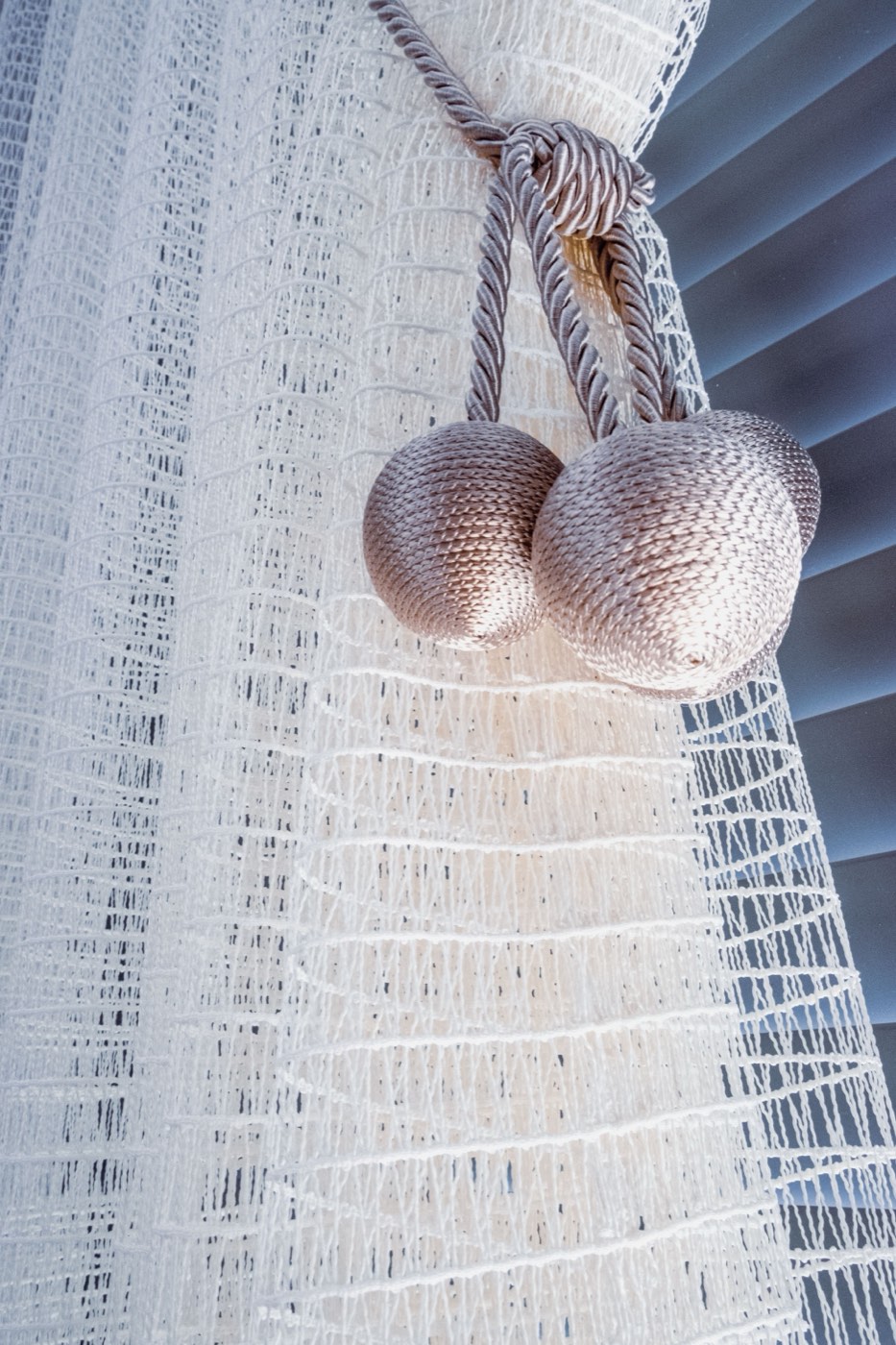
Of everything on a curtain order, tiebacks and holdbacks get the least attention from both sides of the counter. Customers rarely ask for them by name, and a surprising number of retailers don't actively offer them, treating them as a small accessory rather than a line item worth quoting. That's a mistake. A tieback or holdback changes how a curtain actually behaves day to day, and it's one of the lowest-cost, highest-margin additions you can put in front of a customer who has already said yes to the main order.
This guide covers what the two terms actually mean, the main types available, how to size and position them correctly, and how to sell them as a genuine improvement rather than a bolt-on nobody asked for.
Tiebacks vs. holdbacks: what's the difference
The two terms get used loosely, but they describe different hardware with different fitting requirements.
A tieback is a soft, flexible piece, usually fabric, braid, or a tasselled rope, that loops around the curtain and fastens with a hook, button, or velcro tab fixed to the wall. Because it's soft, it folds the curtain fabric back on itself in a gentle curve. Fitting one only requires a small hook or cleat on the wall, which makes it the easier of the two to retrofit on an existing curtain.
A holdback is rigid: a metal, wood, or acrylic arm or hook mounted to the wall, which the curtain rests against or is looped over rather than tied. Because the holdback itself is a visible, fixed object, it reads as hardware in its own right, in the same category as the pole or bracket, and is usually priced and chosen that way.
Both do the same basic job: holding the curtain open against the side of the window. The choice between them is mostly about look and formality, not function.
The main types retailers stock
- Fabric tiebacks. Cut from the same or a coordinating fabric as the curtain, interfaced for structure, and fitted with a hook or loop at each end. The most common choice when the goal is a cohesive, made-to-order look rather than a visible accessory.
- Rope and tassel tiebacks. A twisted cord, often finished with a decorative tassel, sold as a standalone accessory in a range of colours and finishes. Quick to fit, easy to stock in volume, and the simplest upsell to show at the point of sale since they work with almost any heading style.
- Magnetic tiebacks. Two fabric-covered magnetic discs that clip around the curtain from either side, with no hook, button, or wall fixing required. Popular with customers who rent, or who don't want anything screwed into the wall.
- Metal and acrylic holdbacks. Fixed hardware in a range of finishes, usually sold to match the pole or track. The natural pairing is a holdback finished in the same metal as the pole rings and finials, which is also the easiest way to justify the extra cost to the customer.
- Decorative statement holdbacks. Shaped as flowers, shells, or other motifs, generally in period or traditional interiors. A higher-margin, lower-volume item that works best when the customer has already committed to a premium heading like pinch pleat or goblet.
Getting the position right
A tieback or holdback fitted at the wrong height undoes most of its visual benefit, and it's a mistake that's easy to make without a clear rule to follow.
As a starting point, measure from the top of the curtain to the floor, then place the tieback roughly two-thirds of the way down that length. This holds the fabric back at a point where it drapes in a soft curve rather than folding sharply in the middle or bunching too close to the heading. For shorter curtains, such as those finishing at the sill, the same two-thirds rule still applies, scaled to the shorter drop.
Distance from the window frame matters just as much as height. The tieback or holdback should sit far enough out that the gathered fabric doesn't block any of the glass when the curtain is open, and close enough that it doesn't look like the curtain has been dragged halfway across the wall. For most standard windows, that's somewhere between 15 and 20 centimetres out from the frame, adjusted for how much fabric there is to gather back.
It's also worth checking how much the fabric actually folds back on itself once tied. A heavily interlined or blackout-lined curtain holds a fuller, rounder shape when tied back; a light, unlined voile collapses into a thinner curve. The tieback size and the fitting point both need to account for that, not just the window width.
Matching tiebacks and holdbacks to the rest of the order
The most common finish mistake is selling a generic rope tieback alongside a pole with a distinct metal finish, brushed brass, matte black, or antique bronze, and ending up with two unrelated materials in the same sightline. If the customer has already chosen a pole finish, the tieback or holdback should echo it: a metal holdback in the same finish as the pole rings, or a fabric tieback in the same material family as the curtain lining trim, if there is one.
Heading style also limits the options. Wave and S-fold headings are designed to hang in a continuous, even ripple, and tying one back usually flattens the wave rather than creating a soft curve, so it's rarely worth offering on that heading. Pencil pleat, pinch pleat, and eyelet all tie back cleanly and are the headings where this upsell makes the most visual sense.
One more practical point worth raising with the customer at the quote stage: a tieback or holdback is a styling choice as much as a functional one. Some customers want their curtains permanently open during the day for light, in which case a sturdy holdback earns its keep daily. Others only draw curtains back occasionally, in which case a simpler, cheaper tieback is the more sensible sell.
Where retailers leave this upsell on the table
- Not mentioning it at all. If tiebacks and holdbacks don't appear on the standard quote template, most customers never think to ask, and the sale never happens. Build it into the order flow as a question, not an optional add-on buried in a catalogue.
- Giving it away for free. A fabric tieback made from the customer's own curtain fabric costs you a small amount of offcut and a few minutes of making time. Pricing it at zero to close the main sale throws away margin on an item the customer would likely pay for if it were presented as a real choice.
- Selling a mismatched finish. As above: a holdback that doesn't match the pole or the room's other metal finishes looks like an afterthought, even when it isn't one, and undermines the rest of a well-sold order.
- Not showing the customer what it actually looks like. Tiebacks and holdbacks are a visual decision more than a functional one, and customers struggle to picture the effect from a swatch of rope or a line drawing on a spec sheet.
How visualization makes this sell itself
This is a case where the upsell is almost entirely visual, which makes it a natural fit for room visualization. Showing a customer the same curtain, in their own room, both hanging straight and gathered back with the holdback finish they're considering, makes the difference obvious in a way that no amount of describing it can match.
It also opens the door to a slightly bigger conversation than the customer walked in expecting: once they can see the open, gathered look next to the closed one, questions about hardware finish, fullness, and even heading style tend to follow naturally. A small accessory becomes the entry point into a more complete, higher-value order, generated from the same photo that sold the curtains in the first place.
Show every finishing touch before the customer commits
Generate a photorealistic preview of tiebacks, holdbacks, and hardware finishes in the customer's own room. 10 free credits included, no credit card needed.
Get Started Free